On this page
The signature MLB simulation experience within MLB The Show is getting a revamp of its trade technology to be more reflective of reality in this year's release.
Franchise Mode Rebuilding Major Pillars
One of the primary banes of players' existence in sports video games essentially since time immemorial is the presence of "legacy code" — sometimes "spaghetti code" — that has been part of these games' engines for years or even decades, as the requirements of building annual releases off foundations have forced developers to rely on existing code rather than producing new systems. One of the remedies to that is apparently in MLB The Show 26, as the game's trade logic has been "rewritten from scratch," forming one of the pillars of a new foundation to go forward.
Similarly, Franchise is getting revamped lineup and pitcher use logic that is meant to better reflect a modern game that has see sea changes to how the best players in the game are deployed. And in an effort to get casual players into what is at times a dauntingly deep mode, San Diego Studio has rolled out a "streamlined" Franchise experience — albeit at the expense of one of MLB The Show's main modes, March to October, which is no more.
Trade Hub Set to Deepen Player Swapping
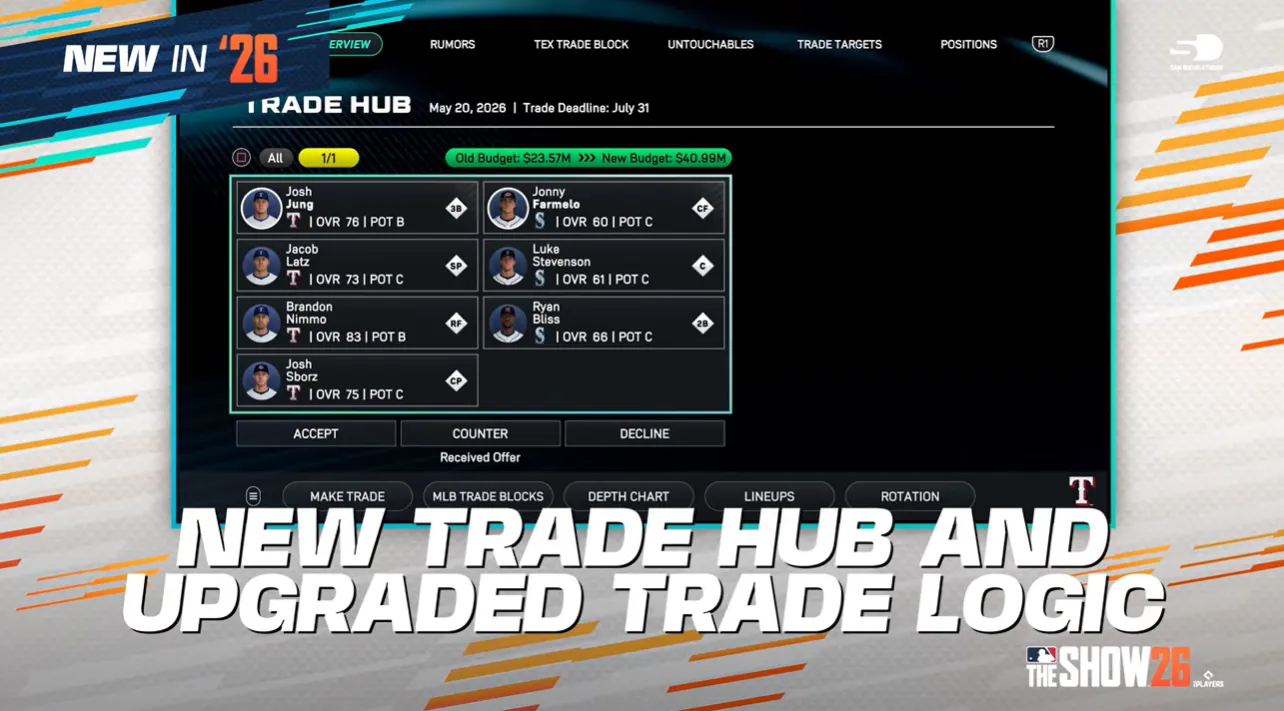
Probably the most prominent change that players will feel in a given Franchise is the introduction of the Trade Hub as a centralized "one-stop shop" for all mechanics related to trading in Franchise. Replacing multiple buttons for a "trade block" and "trade talks" with one menu that allows players to see a wider-angle view of the in-season market for players, the Trade Hub also allows GMs to scan rumors — which may or may not be true — designate players as "untouchables" that will be almost impossible to acquire in trades, and monitor trade targets as the season goes on.
The idea here is solid: As trading is one of the most important — and fun — things that a player can do in Franchise mode, having a more robust system to manage it is something that substantially improves Franchise both from the perspective of players who might want more control of their virtual roster and content creators who now have a way to get more creative with rebuilds or remaking the league. While the trade logic being upgraded such that "no more rippin' off the CPU with unrealistic blockbusters" is one of the things called out by Jessica Mendoza in the trailer for the mode would seem like a governor for the wilder moves — like the one the Pirates (!) pulled in the 2026 season of a Franchise in MLB The Show 25 I simmed through this week, trading Gleyber Torres and Tyler Anderson for none other than Mike Trout, who subsequently powered them to the 2026 World Series crown — the system in practice on SDS's Thursday Feature Premiere live stream appeared to more intelligently match teams with needs and produce more wheeling and dealing by franchises beyond just the user-controlled ones, including blockbusters celebrated with in-game confetti.
With this logic also including competitive factors — like, say, the Athletics currently playing in a minor-league ballpark because of an absurdly miserly owner, the Red Sox and Yankees avoiding deals that might help the other secure an AL East title, or a glut of available shortstops in a given year — and the removal of "insta-trades" in favor of offers that can be built, countered, and edited, there's ample reason to hope this is all the start of a trade system that makes for both more accurate and lively trading in game.
And now you can trade four players at a time! What a massive and meaningful change!
New Lineup and Rotation Logic Revamps Roster Deployment
The other big change in Franchise is a revamp more than a complete rebuild: New logic systems for lineup building and pitcher usage are meant to help CPU teams assemble a batting order more in line with present analytically-aided principles and mirror the move toward expanded rotations and "bullpen games."
The former is simply necessary in 2026, a time when sluggers like Kyle Schwarber are leading off to get the best bats in a lineup more cuts. In reality, gone are the days of slap hitters with speed being the leadoff mainstays without question; now, a more nuanced look at the composition of an order is en vogue, and will hopefully be part of Franchise mode.
And as lineups have gotten smarter, so too have rotations and bullpens, with teams better understanding leverage and rest. This may play out in Franchise with games in which teams stitch together a "starter" from an "opener" and relievers making shorter appearances on the mound, or with the best pitchers in the bullpen being brought out for higher-leverage situations even if a save is not at stake. The bullpen game feature working as both an option for users or a potential one for the CPU is a nice touch, as well.
Streamlining Means Cutting March to October
Unfortunately, the SDS focus on Franchise seems to have come at a cost to The Show more globally: While "Streamlined" Franchise was a major focus of the Feature Premiere stream, that came with confirmation that March to October, a similar but siloed team-control mode that had been in the game for several years, has been removed.
That makes sense when considering allocation of resources. March to October was clearly more curated — last year's version had in-game trailers for each of MLB's six divisions that set the stage for an MTO run with real-life footage and narration, presentation elements that likely took significant time and effort to build — and guided players more considerably than Franchise does, as it was intended to be a beginner's first steps into Franchise-style play. But players were likely not playing more than one or two March to October runs — and if those same players might be down for 10 to 15 seasons in Franchise, getting them into that mode with an experience that automates as much or as little as players want is simply more effective funneling.


